


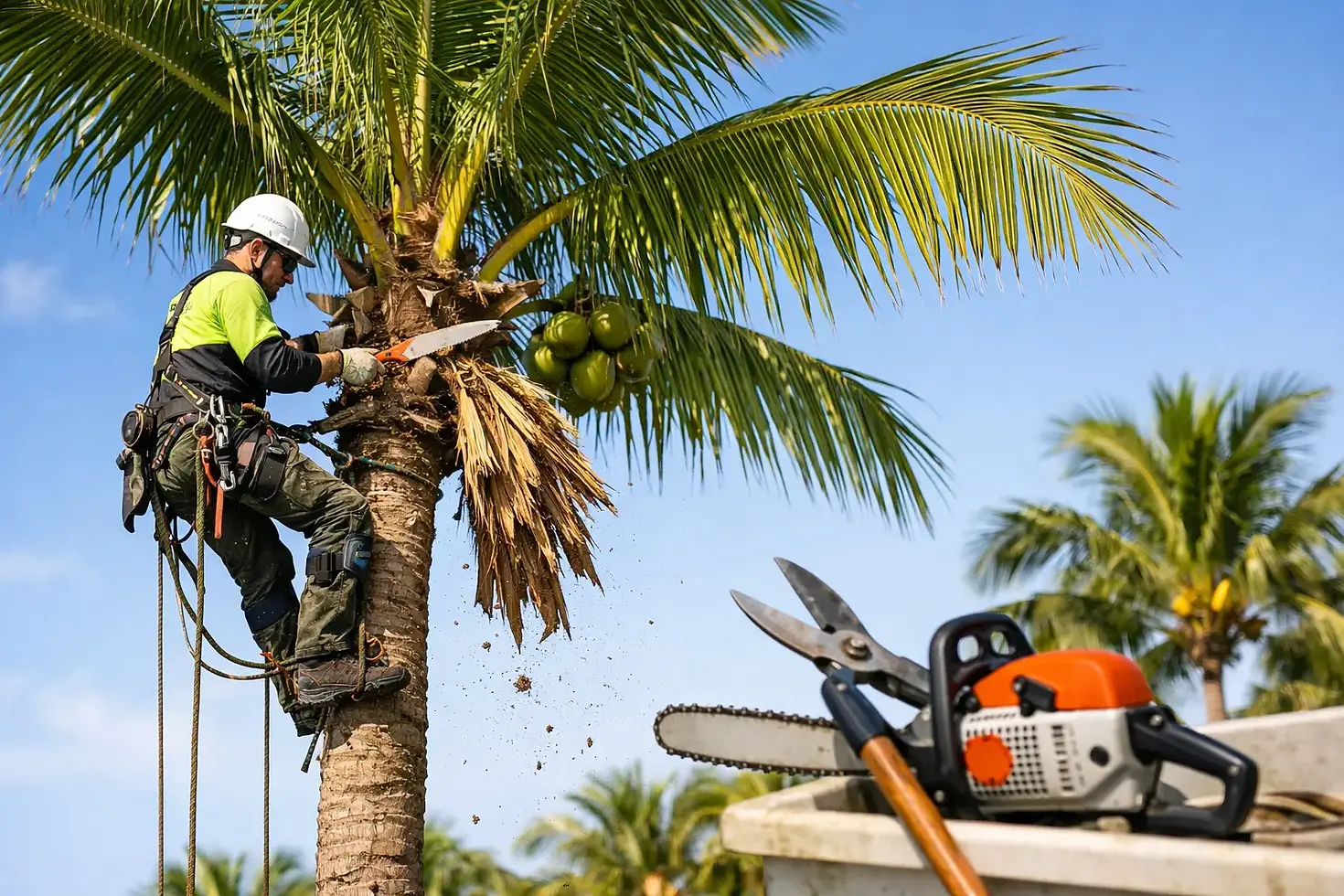
How to Prune Palm Trees Safely

A palm that looks overgrown can tempt a quick trim, especially when dead fronds start hanging near a driveway, roofline, or pool cage. But how to prune palm trees safely is not just about cutting what looks messy. Done the wrong way, palm pruning can injure the tree, create falling hazards, and put the person doing the work in real danger.
For homeowners, landlords, and property managers, the safest approach starts with knowing what should be removed, what should stay, and when the job has moved beyond basic yard work. Palms are common across Florida landscapes, but they do not respond to pruning the same way shade trees do. A careful cut improves clearance and appearance. An aggressive cut can weaken the palm and leave it more vulnerable over time.
How to prune palm trees safely without harming the tree
The first rule is simple: remove only what is dead, broken, diseased, or creating a clear safety issue. Brown fronds that are fully dead can usually come off. Loose seed stalks or hanging fruit may also be trimmed when they create mess, visibility issues, or extra weight. Green, healthy fronds should generally stay in place, even if they droop lower than you prefer.
Many property owners make the mistake of over-pruning palms into a tight, upward-facing shape often called a hurricane cut. It may look neat for a short time, but it strips the tree of healthy fronds that help it produce energy and protect itself. Over-pruned palms often show slower recovery, nutrient stress, and a thinner canopy that does not age well.
A good visual rule is to avoid removing fronds above the horizontal line unless there is a specific hazard or disease concern. If a frond is still green and helping the palm, cutting it just for appearance is usually not worth the trade-off.
When palm pruning is necessary
Not every palm needs regular pruning. Some benefit from occasional cleanup, while others can go longer between visits. The right schedule depends on the species, location, growth rate, and what is underneath the canopy.
Pruning becomes more important when dead fronds are hanging over walkways, parking areas, patios, or utility-adjacent spaces. It is also worth addressing when fruit stalks drop debris into pools, create slip hazards, or attract pests. If storm season is approaching and there are already dead, loose, or cracked fronds, cleanup can reduce the chance of falling material during high winds.
What pruning cannot do is make a healthy palm storm-proof. Removing green fronds does not prepare a palm for severe weather. In fact, excessive cutting can reduce the tree's natural ability to manage stress.
Use the right tools and protective gear
Palm pruning is one of those jobs that looks easier from the ground than it is. Even a small palm can have sharp petiole edges, hidden insects, or heavy fronds that swing unpredictably when cut. Before any work starts, the right equipment matters.
For low, reachable palms, clean hand pruners or a pruning saw may be enough. For higher fronds, pole saws can help create distance, but they also reduce control if the material is heavy or tangled. Chainsaws should be used very cautiously and only by people trained to handle overhead cutting. They are not the right choice for casual ladder work.
Protective gear should include gloves, eye protection, long sleeves, sturdy footwear, and a hard hat if there is any chance of overhead drop. If the trunk has thorns or rough fiber, arm protection can make a big difference. Just as important, tools should be disinfected between trees when disease is a concern.
Ladder safety is where many palm jobs go wrong
The biggest risk in palm pruning is often not the tree itself. It is the unstable setup. Homeowners frequently try to trim palms from extension ladders set on mulch, uneven soil, or wet grass. Then they add one more problem by reaching too far sideways to grab a frond.
That combination is where accidents happen fast. Fronds are heavier than they appear, and once cut, they can twist, pull tools off line, or knock a person off balance. The risk climbs even higher when the palm is close to a fence, pool deck, roof edge, or driveway.
If both feet cannot stay firmly planted in a stable position, the job is already in questionable territory. If climbing gear, aerial access, or rigging would be needed to control falling material, it is time to bring in a professional crew.
How to make clean cuts
When a dead frond is ready to come off, cut it close to the trunk without gouging or shaving the trunk tissue. The goal is a clean removal, not a flush wound. Cutting too deep can damage the palm and create an opening for decay or pests.
Work slowly and in small sections if the frond is large. On heavy material, reducing the weight first helps prevent tearing. Seed pods and fruiting stalks can be removed near their base, again without cutting into the trunk.
If the palm has old boot material or leaf bases attached to the trunk, do not assume they should be stripped away. On many palms, that material is a natural part of the tree's structure and appearance. Removing it for cosmetic reasons can create unnecessary injury and extra labor with little benefit.
Watch for these hazards before you start
Palm pruning can involve more than just sharp tools. Wasps, ants, spiders, and rodents sometimes nest under dead fronds. Some palms have spines that can puncture skin easily. Others grow close to service lines, screen enclosures, or glass features that can be damaged by one uncontrolled drop.
In Florida properties, another factor is timing and weather. Wet conditions make ladders less stable and tools harder to control. Afternoon heat adds fatigue, and fatigue leads to poor decisions. If there is lightning in the area, the work should wait. No trimming job is worth rushing through in unsafe conditions.
There is also a health side to consider. If a palm shows signs of disease such as unusual discoloration, a collapsing spear, trunk damage, or a sudden canopy decline, pruning alone may not solve the problem. In those cases, diagnosis matters as much as cleanup.
When to call a professional for safe palm pruning
Knowing how to prune palm trees safely also means knowing when not to do it yourself. If the palm is tall, near utility lines, hanging over a structure, storm-damaged, or showing signs of disease, professional help is the safer path. The same goes for any situation where dropped material could hit a vehicle, crack a screen enclosure, or injure someone below.
A qualified tree service can assess whether the palm truly needs pruning, remove hazardous fronds with the proper equipment, and clean up the site without damage to the surrounding property. That matters for homeowners, but it matters just as much for landlords and property managers trying to reduce liability.
For properties across Clearwater and the greater Tampa Bay area, palm care often intersects with storm prep, curb appeal, and year-round occupancy. That is one reason many owners prefer a trained crew that can spot structural issues, pest activity, and pruning needs in the same visit rather than treating it like a basic cleanup task.
A few common mistakes to avoid
The most common mistake is over-pruning for appearance. The second is using unsafe access methods. The third is assuming every brown frond is urgent. In reality, some palms naturally hold older fronds for a while, and immediate removal is not always necessary unless there is a hazard.
Another mistake is topping or cutting into the growing point. Palms are not broad-canopy trees with multiple growing tips. Many have a single terminal bud. If that growing point is destroyed, the palm may not recover.
It also helps to avoid pruning on a fixed calendar without looking at actual conditions. Some palms need attention sooner because of fruit drop or deadwood buildup. Others are better left alone until there is a clear reason to trim.
Safe palm pruning is less about making the tree look dramatically different and more about reducing risk without taking away what the palm needs to stay healthy. If you are standing under a tall palm wondering whether the job is simple or risky, that hesitation is worth listening to. A careful decision now can protect both your property and the tree for the long run.


Comments