


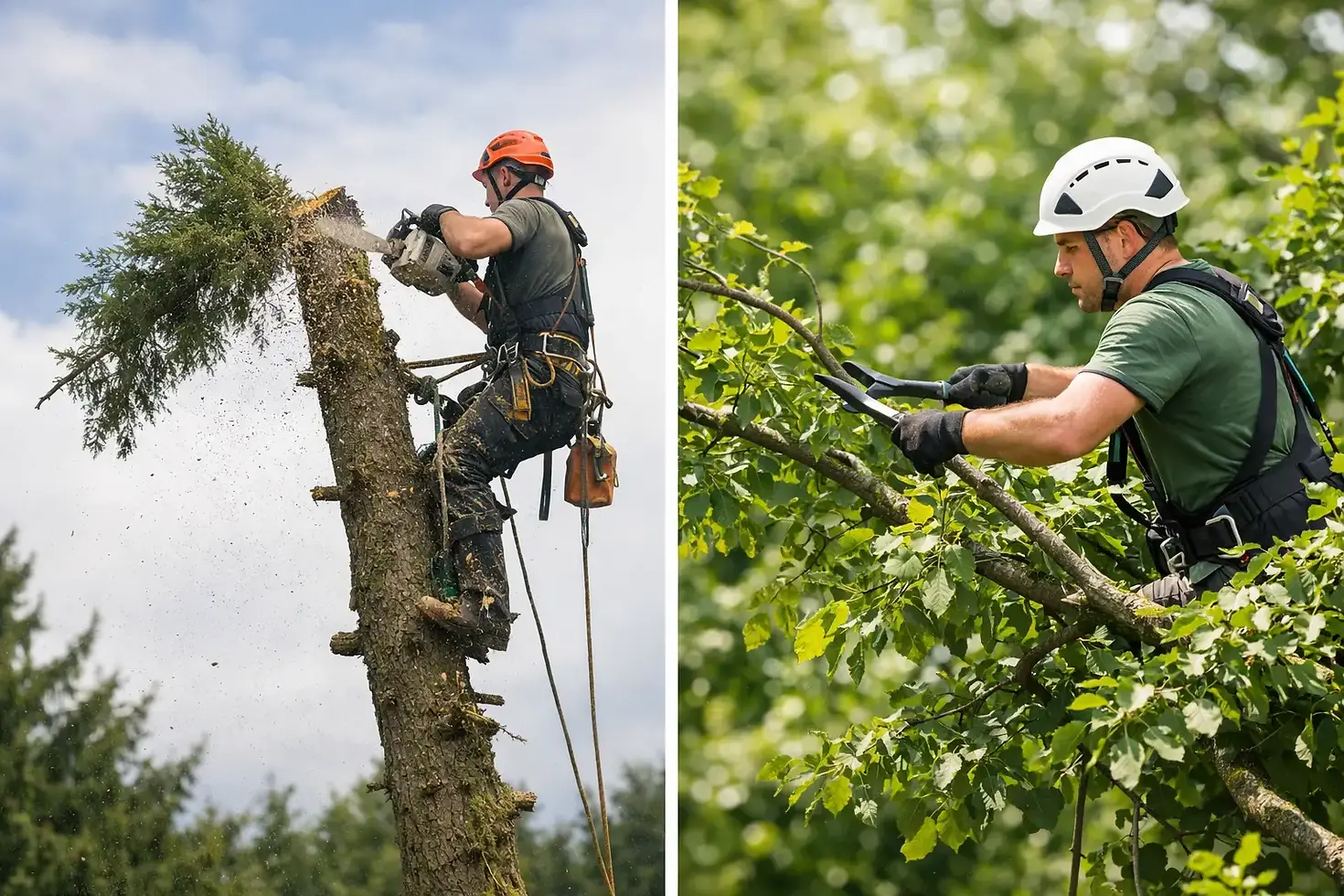
Tree Topping vs Pruning: What’s Safer?

A tree that suddenly looks shorter is not always a tree that has been cared for correctly. When property owners compare tree topping vs pruning, the difference is more than appearance. It affects storm safety, future maintenance costs, curb appeal, and the long-term health of the tree.
For homeowners and property managers, this matters most when a tree starts to feel too large for the yard, hangs over a roof, or shows signs of storm damage. Cutting it back may seem like the obvious answer. But how it is cut makes a major difference in what happens next.
Tree topping vs pruning: the core difference
Tree topping is the practice of cutting back large sections of a tree’s canopy, often by removing the main branches or upper crown to stubs or lateral branches that are too small to support normal growth. It is usually done to reduce height quickly.
Pruning is a selective, intentional method of removing specific branches for a clear purpose. That purpose may be hazard reduction, structural improvement, canopy cleaning, clearance from a home or driveway, better airflow, or healthier growth.
At a glance, both methods remove branches. That is where the similarity ends. Topping is a harsh reduction that ignores the tree’s natural structure. Pruning works with that structure.
Why topping is considered harmful
Topping creates large wounds that a tree may struggle to close. Those cuts expose more internal wood, which can increase the risk of decay, pests, and disease. In Florida’s heat and humidity, that extra stress can become a serious problem, especially on mature trees already dealing with storm exposure or compacted soil.
Another issue is how the tree responds after topping. Many species react by pushing out fast-growing shoots near the cut points. These shoots may look like recovery, but they are often weakly attached. Over time, they can become more likely to break in high winds.
That means topping can actually increase risk rather than reduce it. A homeowner may top a tree because it feels too tall before hurricane season, only to end up with a tree that is structurally weaker and more expensive to manage later.
There is also the appearance factor. Topped trees often look unnatural, uneven, and bare. Some never regain a balanced form. If curb appeal matters, topping usually works against that goal.
What proper pruning is designed to do
Pruning is not about making random cuts until a tree looks smaller. It is about choosing the right branches and making the right cuts in the right places.
A well-pruned tree can be safer, healthier, and better shaped without being stripped of its natural canopy. Depending on the species and condition, pruning may remove deadwood, reduce weight on overextended limbs, improve clearance over structures, or encourage a stronger branch framework.
For residential properties, pruning often solves the real concern behind the request. If branches are scraping the roof, hanging over a pool screen, blocking visibility, or crowding utility space on private property, selective pruning can address those problems without the damage caused by topping.
This is also why certified arborist guidance matters. The best pruning plan depends on the species, age, size, health, location, and recent stress factors affecting the tree.
Can pruning reduce tree height?
Sometimes, yes. But not in the same blunt way as topping.
Crown reduction pruning can reduce the height or spread of a tree when it is done carefully and only when the species and structure allow for it. The cuts are made back to appropriate lateral branches, which helps preserve the tree’s form and lowers stress compared to topping.
This is one of the most misunderstood parts of tree care. Property owners often ask for topping because they want a tree smaller, safer, or farther from the house. In some cases, reduction pruning can achieve enough of that goal. In other cases, the tree may be a poor fit for its location, and removal may be the more honest recommendation.
That is where experience matters. A responsible tree care company should not promise that every oversized tree can simply be cut down to size and left healthy.
When topping is sometimes requested
Most topping requests come from understandable concerns. A tree may feel too close to the roof. A landlord may want quick visibility improvement. A property manager may be trying to reduce storm anxiety before a weather event.
The problem is that a fast visual fix can create a long-term maintenance issue. Topped trees often need repeated cutting because of the aggressive regrowth that follows. That can turn one bad decision into years of extra cost.
There are rare situations involving severe storm damage or utility conflicts where a tree is cut back heavily, but that does not make topping a best practice. Emergency conditions can force difficult choices. Even then, the goal should be to stabilize the site and decide whether the tree can be properly managed or should be removed.
How this plays out on Florida properties
In the Tampa Bay area, trees deal with intense sun, saturated summer soils, strong wind events, and occasional hurricane impacts. That combination makes structure especially important.
A tree with weak regrowth after topping is not in a great position when storm season arrives. The same goes for a tree that has lost too much canopy and is suddenly exposed in ways it was not before. Sunscald, stress, and poor compartmentalization of large wounds can all become part of the problem.
Pruning, by contrast, can be part of a practical storm-prep strategy when it is done correctly. Removing dead limbs, reducing end weight on vulnerable branches, and correcting obvious structural issues can lower the chance of breakage without destroying the tree’s natural defenses.
For many local property owners, that balance is the real goal. They do not just want a tree smaller. They want it safer and more manageable without creating a new hazard.
How to tell if a tree was topped
A topped tree usually has blunt branch ends, a flat or uneven canopy line, and clusters of upright shoots growing from old cut points. It may look hacked back rather than naturally shaped.
If you see thick limbs cut to stubs with no regard for branch collars or natural growth points, that is a strong sign. The tree may also have sparse interior coverage at first, followed later by dense, whippy regrowth.
If a previous owner had work done years ago, the tree may still be dealing with the results. That does not always mean the tree is beyond help, but it does mean future care should be planned carefully.
What to ask before approving any cutting
Before any major canopy work begins, ask what the objective is. Is it clearance, storm risk reduction, health improvement, visibility, or size management? The answer should shape the method.
You should also ask where cuts will be made and why. A professional should be able to explain the approach in plain language. If the plan is simply to chop the top off and make the tree shorter, that is a red flag.
It also helps to ask what the tree will likely look like in one year and in five years. Good pruning is planned with future growth in mind. Topping rarely is.
The better choice for most properties
In the debate over tree topping vs pruning, pruning is almost always the better option when the goal is safety, appearance, and long-term tree health. It is more precise, more responsible, and more likely to solve the actual problem without creating new ones.
That does not mean every tree can be saved with pruning alone. Some trees are too damaged, too decayed, or too poorly located to remain safe. But even in those cases, the answer is not to top the tree and hope for the best. The answer is an informed assessment and a clear recommendation based on risk and condition.
At Campbells Noble Tree Service LLC, that is the standard property owners deserve - honest guidance, certified expertise, and work that protects both the tree and the people around it.
If a tree on your property feels too large, too close, or too risky, the next step is not guessing which branches to cut. It is having the tree evaluated so the solution fits the tree, the site, and the safety of everyone who uses that space.


Comments